+
Positive Oxidation Number
An atom has a positive oxidation number when it has fewer electrons assigned to it than in the neutral atom.


Understanding oxidation states, assigning oxidation numbers and calculating the oxidation number of elements in compounds and ions.
Understanding the oxidation state of an atom.
Oxidation numbers have a variety of uses in chemistry — from writing formulae to predNDAing properties of compounds and assisting in the balancing of oxidation-reduction reactions in which electrons are transferred.
The oxidation number (or oxidation state) of an atom can be zero, positive, or negative.
An oxidation number of zero means the atom has the same number of electrons assigned to it as there are in the free neutral atom. All elements in their free state (uncombined with other elements) have an oxidation number of zero.
An atom has a positive oxidation number when it has fewer electrons assigned to it than in the neutral atom.
An atom has a negative oxidation number when it has more electrons assigned to it than in the neutral atom.
All elements in their free, uncombined state have an oxidation number of zero.
How electron loss and gain determine ionic charges.
The oxidation number of an atom that has lost or gained electrons to form an ion is the same as the positive or negative charge of the ion.
For example, in sodium chloride (NaCl), the oxidation number is +1 for the Na⁺ ion and −1 for the Cl⁻ ion.
Eight important rules for correctly assigning oxidation numbers to elements in compounds and ions.
All elements regardless of whether they are monatomic, diatomic or triatomic have an oxidation number of zero.
The algebraic sum of the oxidation numbers of the atoms in a neutral molecule is zero.
The algebraic sum of the oxidation numbers of the atoms in a polyatomic ion is equal to the charge on the ion.
Oxidation number of H is +1, except in metal hydrides, where it is −1.
Oxidation number of O is −2, except in peroxides, where it is −1, and in OF₂, where it is +2.
The metallic element in an ionic compound has a positive oxidation number. Alkali metals in combined state have +1, while alkaline earth metals have +2.
The oxidation number of halogens in compounds is generally −1. In interhalogen compounds and certain oxygen-containing compounds, it can be positive.
In covalent compounds, the negative oxidation number is assigned to the more electronegative atom.
Follow these three systematic steps to determine the unknown oxidation number in a compound or ion.
Write the oxidation number of each known atom below the correct position of the atom in the formula.
Multiply each oxidation number by the number of atoms of the element in the compound.
Write an expression indicating the sum of all oxidation numbers. Set it equal to zero for a neutral compound or to the charge for an ion.
Neutral compound: Sum of oxidation numbers = 0
Polyatomic ion: Sum of oxidation numbers = Ion charge
Determine the oxidation number of sulphur in sulphuric acid.
Sulphuric Acid
∴ Oxidation number of sulphur = +6
Determine the oxidation number of manganese in the permanganate ion MnO₄⁻.
Permanganate Ion
∴ Oxidation number of manganese = +7
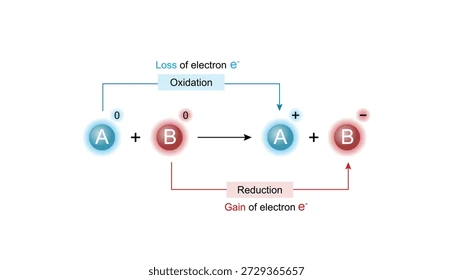
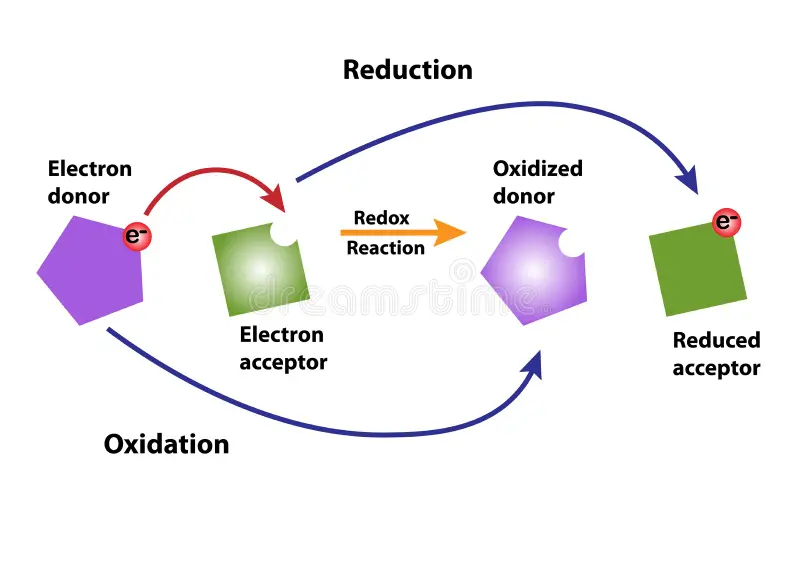
Electron transfer is the fundamental process behind oxidation-reduction reactions.
Oxidation occurs when an atom or ion loses electrons. Its oxidation number increases.
Reduction occurs when an atom or ion gains electrons. Its oxidation number decreases.
Essential concepts to remember from Lesson 3.1.
The oxidation number (or oxidation state) of an atom represents the assigned electron distribution of an atom in a chemical species.
A positive oxidation number indicates that fewer electrons are assigned to an atom than in its neutral state.
A negative oxidation number indicates that more electrons are assigned to an atom than in its neutral state.